Hogar

Blog

Blog

  • How to Prevent Logo Distortion When Printing on Curved Balls
    How to Prevent Logo Distortion When Printing on Curved Balls
    Oct 16, 2026
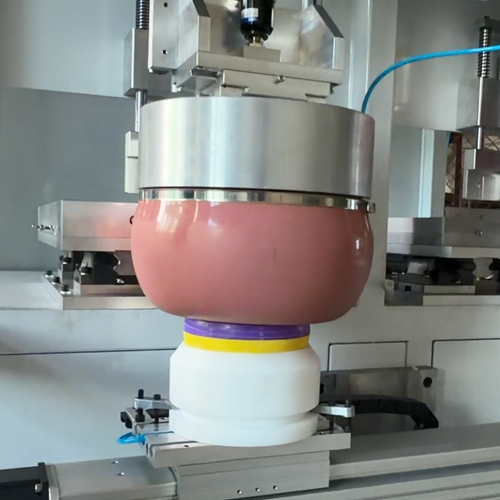
    A logo that looks correct in a flat artwork file may become stretched, compressed, tilted, or uneven after it is transferred onto a ball. Golf balls, PVC or PU balls, rubber balls, toy balls, and other spherical products can all face this problem during printing. The cause is not simply the curved surface itself. In most cases, logo distortion is the combined result of artwork geometry, silicone pad deformation, ball movement, fixture design, printing pressure, and ink transfer conditions. Stable ball pad printing requires the artwork, silicone pad, printing plate, fixture, ball condition, and process parameters to be developed as one complete system.   Why Logos Distort on Curved Ball Surfaces During pad printing, the flexible silicone pad picks up a flat ink image from the printing plate and then conforms to the curved ball surface to complete the transfer. As the pad wraps around the spherical surface, different areas of the image travel different distances. The center area usually makes contact first, while the outer areas must travel across a greater surface angle. If the ball moves, the pad is too soft or too small, or excessive pressure is applied, the image can become further distorted. Common distortion problems include: A circular logo becomes oval. The center of text becomes wider while both sides become narrower. Straight lines become curved after printing on the ball. One side of the image becomes longer than the other. Multi-color graphics show registration errors. The center prints clearly while the outer areas show missing ink or breaks. Because these defects can result from several factors acting together, adjusting only one machine parameter often provides only temporary improvement and does not create a stable, repeatable solution.   1. Define a Realistic Print Area The wider a flat image extends across a spherical surface, the more obvious the geometric change during transfer usually becomes. A small logo placed within a relatively stable area of the ball is easier to print clearly and consistently than a large image extending far toward both sides of the ball. Before making the printing plate, confirm: Ball diameter and surface profile Actual logo size Distance from the printing center to the steepest edge of the image Whether the surface is smooth, dimpled, textured, soft, or inflatable Whether each ball requires one printing position or multiple indexed positions If the artwork width already exceeds the reasonable range for one stable transfer, the image can be reduced in size, divided into multiple printing positions, or produced using a controlled ball rotation process. Conventional localized pad printing should not be described as seamless full-ball coverage printing.     2. Compensate the Artwork After a Physical Test Artwork compensation means adjusting the image on the printing plate in advance so that, after transfer distortion, the image appears visually correct on the ball. Compensation must be based on actual measurement results rather than experience or guesswork alone. One practical method is to first print a reference grid, concentric circles, or dimensioned test marks on the actual ball. Measure which areas become stretched, compressed, or curved, and then make corrections in the opposite direction in the artwork. Example If one area consistently becomes wider after printing on the ball, that area can be locally narrowed in the plate artwork. Unless the distortion is completely uniform across the entire image, do not scale the whole logo by the same ratio. Distortion at the center of a spherical surface is usually different from distortion at the outer areas. Local compensation should be used and confirmed through another round of sample measurement. Compared with continuously changing several parameters at the same time, two or three rounds of controlled testing usually make it easier to identify the truly effective solution.     3. Match the Silicone Pad to the Ball and Artwork The silicone pad connects the flat printing plate with the curved product surface. Its shape, size, contour, and hardness directly affect how the image expands during transfer. A silicone pad used for ball printing should: Be large enough to fully cover and extend slightly beyond the entire image. Have a contact profile that rolls through the image without trapping air. Conform to the ball surface without excessive lateral stretching. Recover its original shape consistently after each printing cycle. Avoid placing an unstable pad tip directly over critical logo details. A pad that is too soft can expand outward and widen the image. A pad that is too hard may fail to cover highly curved or textured outer areas. A pad that is too small requires greater deformation to cover the entire image and can also increase distortion risk. The correct choice is not simply the hardest or largest pad. The goal is to select a pad that can transfer the entire image with the lowest practical pressure while producing the least possible deformation.     4. Use a Dedicated Ball Fixture Even when the pad and artwork are correctly matched, stable results cannot be achieved if the ball moves during contact. A dedicated fixture should keep the position and orientation of the ball consistent in every printing cycle while leaving sufficient contact space around the printing area. Soft or hollow balls require particular attention. Excessive clamping force can change the shape of the ball before printing, causing the image to look correct while the ball is held in the fixture but become distorted after the ball returns to its original shape. The fixture must therefore stabilize the product without squeezing it out of shape.     5. Use Only the Pressure Needed for Complete Transfer Excessive pressure is one of the common causes of logo distortion. Once the pad has fully contacted the target printing area, further compression mainly pushes the silicone outward. This can widen the center of the image, drag the edges, and create greater printing variation as the pad ages. Ink Pickup Pressure Use the lowest effective pressure that can completely pick up the image from the printing plate. Avoid bottoming out the pad or causing it to slide. Printing Pressure Start with low pressure and increase it gradually only until the target image transfers completely. Where the geometry allows, the spherical printing area should also face the pad as directly as possible. If the fixture tilts the printing surface, one side will contact first and experience greater lateral movement. Correcting the fixture angle is often more effective than simply increasing pressure.     6. Stabilize the Plate, Ink, and Transfer Window A logo that appears distorted can sometimes also be affected by the condition of ink transfer. If the ink is too wet, it can smear or spread while the pad is compressed. If it dries too quickly, the outer areas may not release completely, making the image appear narrower or broken. Changes in ink viscosity can also cause image dimensions to vary within the same production batch. Variables that should be controlled include: Printing plate quality and etching depth Ink supply method and ink cup condition Ink-to-hardener ratio when using two-component inks Type and proportion of thinner Ambient temperature, airflow, and machine idle time Time between ink pickup and transfer Pad cleanliness and surface condition The ink must also match the ball material. PVC, PU, rubber, and different plastics may require different ink systems, surface cleaning, pretreatment, or curing conditions. Good adhesion cannot directly correct geometric distortion, but poor wetting or incomplete release can make geometric problems appear more severe.     7. Control Registration for Multiple Colors and Positions Multi-color ball printing adds two additional risks: the ball may rotate between colors, and different pads may produce different levels of image distortion. Clear registration references or controlled indexing should be used instead of relying only on visual positioning by the operator. To achieve stable registration: Use the same positioning reference and ball-center height at every station. Keep pad shape and compression conditions matched between different color stations. Confirm that the previous color has reached a suitable stable condition before the next contact. Check registration at the outer edges as well as at the center of the image. Use vision positioning or inspection when tolerance and artwork requirements genuinely require it. If multiple logos must be printed around the same ball, both rotational angle and axial position must be controlled. Even a small angular error can create an obvious positional deviation at the edge of the logo.     A Practical Distortion Test Procedure 1 Record the product conditions Record the ball material, diameter, surface texture, parting line or air-valve position, inflation condition, and target printing position. 2 Prepare a test artwork Include a grid, circles, horizontal lines, vertical lines, and the actual logo outline. 3 Lock the mechanical conditions Install the selected fixture and pad and maintain a repeatable ball-center height. 4 Start with low pressure Increase pressure only until complete ink pickup and transfer are achieved. 5 Print a controlled sample group Keep ink preparation, cycle time, and environmental conditions consistent. 6 Measure the results Compare dimensional changes in the printed grid and logo at both the center and outer areas. 7 Change only one variable at a time Adjust the artwork, pad, fixture angle, or pressure separately so that the true effect of each variable can be identified. 8 Confirm repeatability The process should only be confirmed when consecutive samples remain within the agreed visual and positional standards.   Material Specific Considerations Golf Balls The dimpled surface contains many small height variations, so pad contour, image size, and ink release must be tested together. If the logo crosses too many or excessively deep dimples, edge detail may decrease even when the overall image shape is correct. Table Tennis Balls The thin shell structure can deform under clamping force or pad pressure. Use gentle and repeatable support to avoid pressing the ball out of round. The ink and curing conditions must also match the ball material. PVC and PU Balls Inflation level changes the curvature and hardness of the printing area. A consistent inflation condition should be specified for both sampling and production. Flexible surfaces may also move under the pad, so fixture support and lower printing pressure are particularly important. Rubber and Toy Balls Surface texture, release agents, and material formulations may vary. Actual production samples should be used to confirm cleaning methods, pretreatment, and ink compatibility rather than making assumptions based only on the general material category. Develop the Process Around the Actual Ball Stable spherical printing results come from matching the artwork, silicone pad, fixture, ball condition, and ink process as one complete system, followed by verification through controlled sample testing. WINNEO Ball Pad Printing Solutions WINNEO can develop ball pad printing solutions according to product diameter, material, surface texture, artwork, number of colors, and target output. After receiving ball samples and vector artwork, the printing area, fixture, silicone pad, and process configuration can be evaluated before equipment selection. Ball Pad Printing Machine for Football & Sports & Toy Balls | WINNEO
    LEER MÁS
  • Tungsten Carbide vs Tungsten-Titanium Pad Printing Rings for Pad Printing: How to Choose?
    Tungsten Carbide vs Tungsten-Titanium Pad Printing Rings for Pad Printing: How to Choose?
    Sep 09, 2026
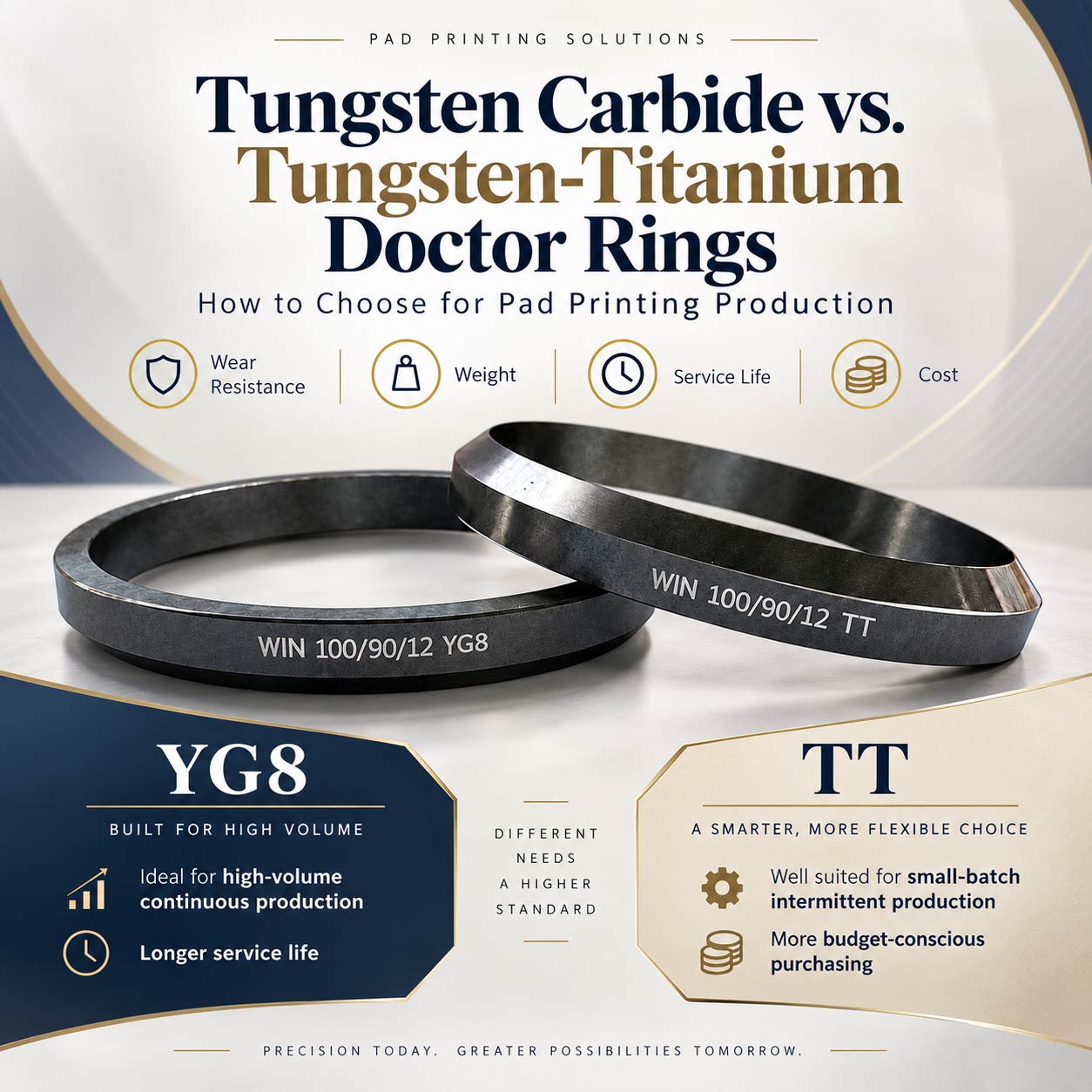
      In pad printing production, the pad printing ring used in a sealed ink cup may look like a small consumable component, but it plays an important role in ink doctoring quality, ink cup movement, production stability, and maintenance frequency. Different pad printing ring materials offer different levels of wear resistance, weight, service life, and cost. For this reason, choosing a pad printing ring should not simply be about selecting the most expensive option. The better approach is to match the ring material with your production volume, operating frequency, application conditions, and cost requirements. WINNEO currently offers two common alloy pad printing ring options: YG8 Tungsten Carbide Ring TT Tungsten-Titanium Ring Although the two rings can have very similar dimensions and appearance, their material composition and application positioning are quite different.   1. Key Differences Between YG8 Tungsten Carbide and TT Tungsten-Titanium Rings Using the WINNEO 100 × 90 × 12 mm test specification as an example, the differences between the two materials are relatively clear. Item YG8 Tungsten Carbide Ring TT Tungsten-Titanium Ring Model YG8 TT Test Size 100/90/12 mm 100/90/12 mm Main Ingredients WC 91%, Co 8%, Other 1% WC 20%, TiC 60%, Co/Ni 18% Scratch Resistance ≥300,000 cycles ≤200,000 cycles Sample Weight 203.64 g 99.31 g Price Positioning More sensitive to tungsten material prices More cost-friendly Recommended Use High-volume continuous production Small-batch or intermittent production It is important to note that: Scratch-resistance cycles should be treated as reference data rather than a guaranteed service-life figure. Actual pad printing ring life depends on many operating factors, including the condition of the printing plate, ink type, doctoring pressure, ink cup installation, machine setup, cleaning and maintenance practices, and the production environment.   Why Is the YG8 Tungsten Carbide Ring Much Heavier? For the same 100/90/12 mm sample size: YG8 Tungsten Carbide Ring: 203.64 g TT Tungsten-Titanium Ring: 99.31 g The difference is significant. This does not come from a difference in ring dimensions. It mainly comes from the different densities of the materials. The YG8 ring contains a high percentage of WC, or tungsten carbide, which has a relatively high density. As a result, a tungsten-carbide-rich ring tends to be considerably heavier at the same dimensions. The TT ring contains a higher proportion of TiC, or titanium carbide, resulting in a lower overall material density and therefore a lighter ring. In this case, product weight provides a simple and intuitive indication of the difference between the two alloy systems.   YG8 Tungsten Carbide Ring: Designed for Higher-Duty Production The primary advantage of the YG8 tungsten carbide pad printing ring is its: higher wear resistance and more stable performance during long-term operation. WINNEO reference testing shows: ≥300,000 doctoring cycles For factories operating pad printing equipment for long periods each day, replacing a pad printing ring involves more than just the cost of the consumable itself. A ring replacement may also require: Machine downtime Ink cup removal Ink cup cleaning Pad printing ring replacement Reinstallation Contact adjustment between the ink cup and printing plate Doctoring tests Production restart For high-volume manufacturing, longer and more stable pad printing ring life can therefore help reduce maintenance frequency and unplanned production interruptions. YG8 is particularly suitable for: High-volume continuous production Ideal when pad printing machines operate for extended periods every day. High-duty printing environments Suitable for applications involving a large number of repeated doctoring cycles. Factories looking to reduce ring replacement frequency Although the initial purchase cost may be higher, longer service intervals can help improve the overall operating cost.     4. TT Tungsten-Titanium Ring: A More Cost-Oriented Alternative Compared with YG8, the TT tungsten-titanium ring uses a lower proportion of tungsten carbide and a higher proportion of materials such as titanium carbide. One direct result is: a lighter pad printing ring with a more cost-friendly purchase price. WINNEO's reference scratch-resistance figure is: ≤200,000 cycles This means that under very intensive, continuous production, its wear resistance is generally lower than that of YG8. However, not every pad printing application requires more than 300,000 doctoring cycles. For example, some factories: operate machines for only a few hours per day; produce relatively small batches; frequently change product models; or mainly handle customized, short-run production. In these situations, extremely long theoretical service life may not provide enough additional value to justify a higher initial material cost. For these users, the TT ring can provide a more economical solution.     5. Why Do Tungsten Prices Affect YG8 Pad Printing Ring Prices? Approximately 91% of the YG8 composition is WC tungsten carbide. This means tungsten-related raw materials represent a significant part of the total material cost. When market prices for tungsten, cobalt, or related materials fluctuate, the manufacturing cost of high-tungsten-content pad printing rings can also change. As a result, customers may occasionally notice that the price of the same tungsten carbide ring specification changes between different purchasing periods. This is not necessarily caused by machining costs alone. Raw material prices can be an important factor. Because the TT ring uses a lower proportion of WC, it can provide a more flexible alternative when purchase cost is an important consideration.     6. How Should You Choose Between YG8 and TT? If your production involves: Long daily machine operating hours High production volume Continuous production runs A strong need to reduce maintenance and ring replacement then: YG8 Tungsten Carbide Ring is generally the more appropriate choice. In these production environments, wear resistance and longer replacement intervals can be more important than the initial purchase price of a single pad printing ring. If your production involves: Small-batch orders Intermittent production Machines that do not operate continuously Greater sensitivity to initial purchasing cost Acceptable pad printing ring replacement frequency then: TT Tungsten-Titanium Ring may provide a more economical solution.   7. Don’t Compare Purchase Price Alone—Consider Total Operating Cost A common mistake when purchasing pad printing consumables is to compare only: the price of one pad printing ring. In real production, however, the total cost should include: pad printing ring cost + replacement frequency + machine downtime + setup time + maintenance labor. For example: A less expensive ring that requires frequent replacement may not necessarily be cheaper over the long term. On the other hand, if production volume is relatively low, purchasing the highest-wear-resistance ring may not provide enough additional economic value. Therefore: The most cost-effective pad printing ring is the one that matches your actual production needs.     8. What Else Affects Pad Printing Pad Printing Ring Life? Material is only one factor affecting pad printing ring life. Actual performance can also be influenced by: Printing plate surface condition Surface roughness, scratches, burrs, or abnormal plate wear can accelerate pad printing ring wear. Contact between the ring and printing plate Excessive ink cup pressure or uneven contact can lead to localized wear. Ink and solvent systems Different inks and solvents may influence the operating conditions of the sealed ink cup system. Machine operating speed Higher-speed continuous operation creates more doctoring cycles within the same period. Installation and cleaning Incorrect installation, removal, or cleaning methods may shorten the practical service life of the ring. For this reason, even when two factories use exactly the same ring model, their actual service life can be quite different. Conclusion: It’s Not About Which One Is Better—It’s About Which One Fits YG8 tungsten carbide and TT tungsten-titanium pad printing rings should not simply be viewed as a “premium” and “basic” option. A more accurate distinction is: YG8: Wear Resistance First Better suited to high-frequency, high-volume, continuous production where reducing ring replacement and machine downtime is important. TT: Cost Flexibility First Better suited to small-batch or intermittent production where initial purchase cost is a more important consideration. The final choice should be based on your machine model, ink cup dimensions, production volume, daily operating hours, and maintenance requirements. If you are unsure which material is suitable for your pad printing application, the selection can also be evaluated according to your existing ink cup size, pad printing ring dimensions, machine model, and production frequency.  
    LEER MÁS
  • Pad-Printing Thin Cliché Plates: Vertical Grain vs. Horizontal Grain — What Is the Real Difference?
    Pad-Printing Thin Cliché Plates: Vertical Grain vs. Horizontal Grain — What Is the Real Difference?
    Sep 02, 2026
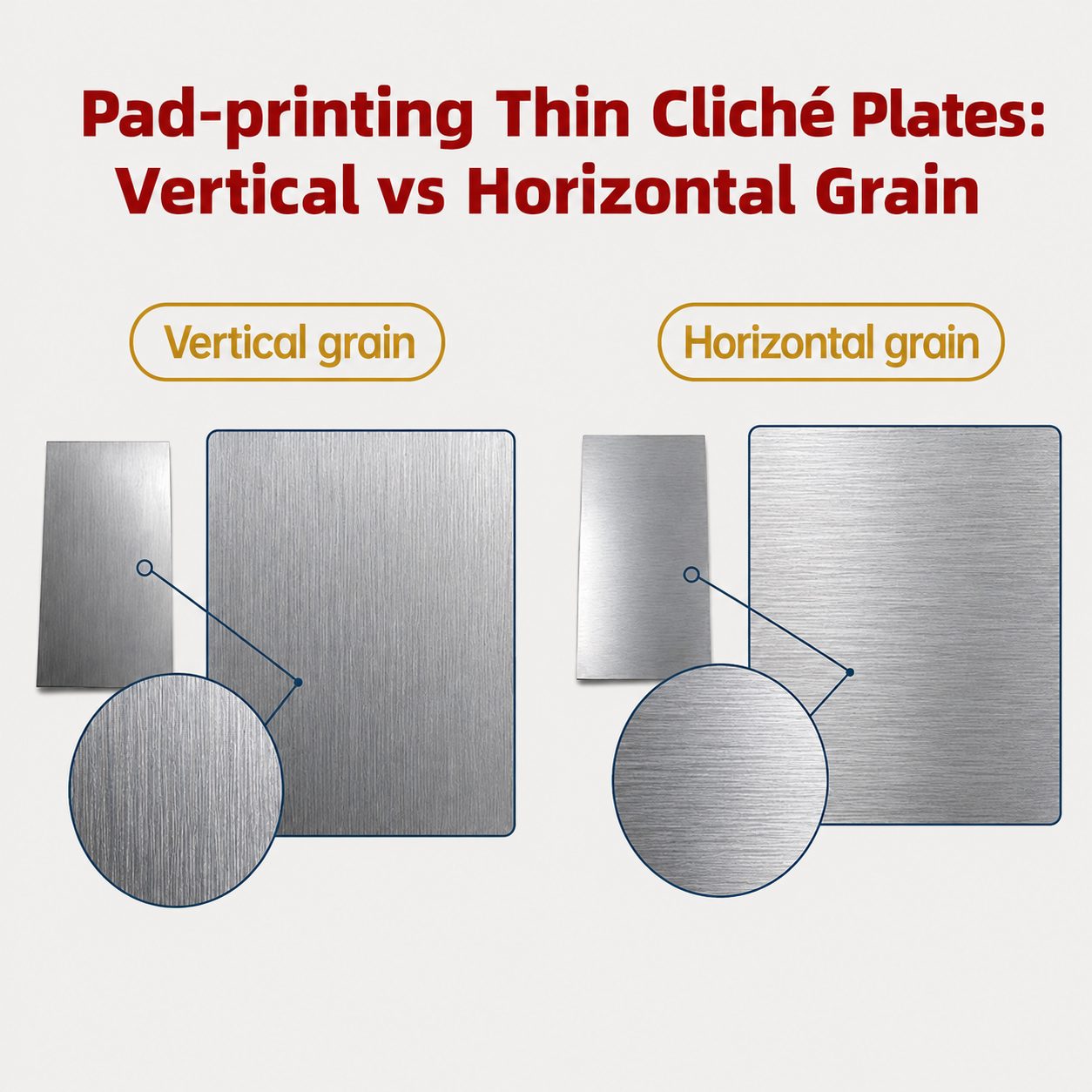
      In pad printing, manufacturers often pay close attention to steel quality, hardness, etching depth and ink formulation. However, there is another small detail that can influence doctoring performance: The grain direction of the cliché plate surface. WINNEO thin cliché plates are manufactured from premium Swedish Sandvik steel. Depending on the application, we provide both standard Vertical Grain plates and customized Horizontal Grain plates. So, what is the actual difference?   1. What Do “Vertical Grain” and “Horizontal Grain” Mean? The terms do not simply refer to how the plate is visually positioned. What really matters is the relationship between the surface grain direction and the doctor-blade or ink-cup travel direction. Vertical Grain: The surface grain runs approximately parallel to the doctoring direction. Horizontal Grain: The surface grain runs approximately perpendicular to the doctoring direction. Although the difference may appear minor, it can influence ink residue during continuous doctoring.     2. Why Can Horizontal Grain Produce Cleaner Doctoring? Even when a cliché plate appears perfectly smooth to the naked eye, its surface still contains very fine microscopic machining lines. These lines can be considered extremely small grooves. When the grain runs parallel to the doctoring direction, some ink can more easily follow these microscopic channels and remain on the plate surface. Depending on the ink viscosity and operating conditions, this may contribute to: •A thin ink film outside the etched image •Slight darkening of the plate after doctoring •Ink streaking •Residual ink lines •Increasing contamination during continuous production With horizontal grain, however, the surface lines run across the doctoring direction. This effectively interrupts the continuous microscopic channels along which ink could otherwise travel. As a result, the doctor blade or ink-cup ring can remove ink from the non-image area more effectively in certain applications. This is why horizontal-grain cliché plates can offer: lower ink residue, cleaner doctoring and more consistent printing performance.     3. Why Is This Particularly Relevant for Closed Ink-Cup Systems? In a closed ink-cup pad-printing system, surface grain influences more than just ink removal. It can also affect the contact condition between the doctor ring and cliché plate. The ceramic or carbide doctor ring needs to maintain stable and continuous contact with the plate. If microscopic surface channels run continuously in the same direction as the ink cup travels, a very small amount of ink may more easily remain within those channels after the ring passes. Horizontal grain interrupts these continuous paths. For this reason, horizontal-grain plates can be particularly useful for applications involving: Larger printing areas Fine or demanding graphics Products sensitive to background ink contamination Low-viscosity inks Continuous production Closed ink-cup systems requiring particularly clean doctoring     4. Why Is Vertical Grain Still the Standard Choice? This does not mean that vertical-grain plates are inferior. In fact, vertical-grain cliché plates perform perfectly well for the vast majority of conventional pad-printing applications. With the correct ink viscosity, a good doctor ring, proper machine adjustment and suitable plate quality, vertical-grain plates can provide highly stable and reliable printing results. This is why WINNEO supplies vertical grain as the standard configuration. Its advantages include: •Broad application compatibility •Mature and stable manufacturing •Suitability for most standard pad-printing jobs •Good cost-performance •Easier stocking and delivery Horizontal grain should therefore be viewed as an application-specific optimization, rather than a replacement for every standard plate.     5. More Visible Grain Does Not Mean Better Doctoring There is another important point: Horizontal grain does not mean that the surface should be rougher. The ideal cliché plate requires: Fine and uniform surface texture Controlled surface roughness Excellent flatness Consistent grain direction Proper compatibility with the doctor ring If the surface texture is excessively rough, even a horizontal grain may contribute to: •Ink trapped inside the surface texture •Faster doctor-ring wear •Ink residue •Unstable doctoring •Printing defects around the image Therefore, cliché-plate performance should never be evaluated solely by asking whether it is horizontal or vertical grain. Steel quality, surface roughness, flatness, etching quality, doctor-ring condition, ink viscosity and machine settings all work together.     6. Which Grain Direction Should You Choose? A practical way to understand the difference is: Vertical Grain — Standard Choice Suitable for the vast majority of conventional pad-printing applications and provides reliable performance under normal operating conditions. Horizontal Grain — Optimized Choice Worth considering when cleaner doctoring is required, or when a customer is experiencing noticeable ink residue or streaking on the plate. However, changing the grain direction alone cannot solve problems caused by poor plate flatness, a worn doctor ring, excessively thin ink or incorrect machine settings. The better approach is to select the cliché plate according to: machine configuration, ink-cup size, image area, ink characteristics and actual doctoring conditions.   WINNEO Recommendation Surface grain may appear to be a small detail, but in pad printing, small details often determine long-term production stability. If you are experiencing: incomplete doctoring, ink residue, streaking, dirty backgrounds or reduced cleanliness during continuous production, in addition to checking the doctor ring, ink viscosity and machine settings, it may also be worth checking: whether the cliché plate grain direction matches your doctoring application. For most standard jobs, vertical grain is sufficient. For applications requiring cleaner doctoring performance, horizontal grain can provide an additional optimization option. The right cliché plate should not only make printing possible — it should help the entire pad-printing system operate more consistently.  
    LEER MÁS
  • Automatic Food Tray Labeling Machine: A Practical C-Wrap Solution for Three- and Four-Side Labeling
    Automatic Food Tray Labeling Machine: A Practical C-Wrap Solution for Three- and Four-Side Labeling
    Aug 17, 2026
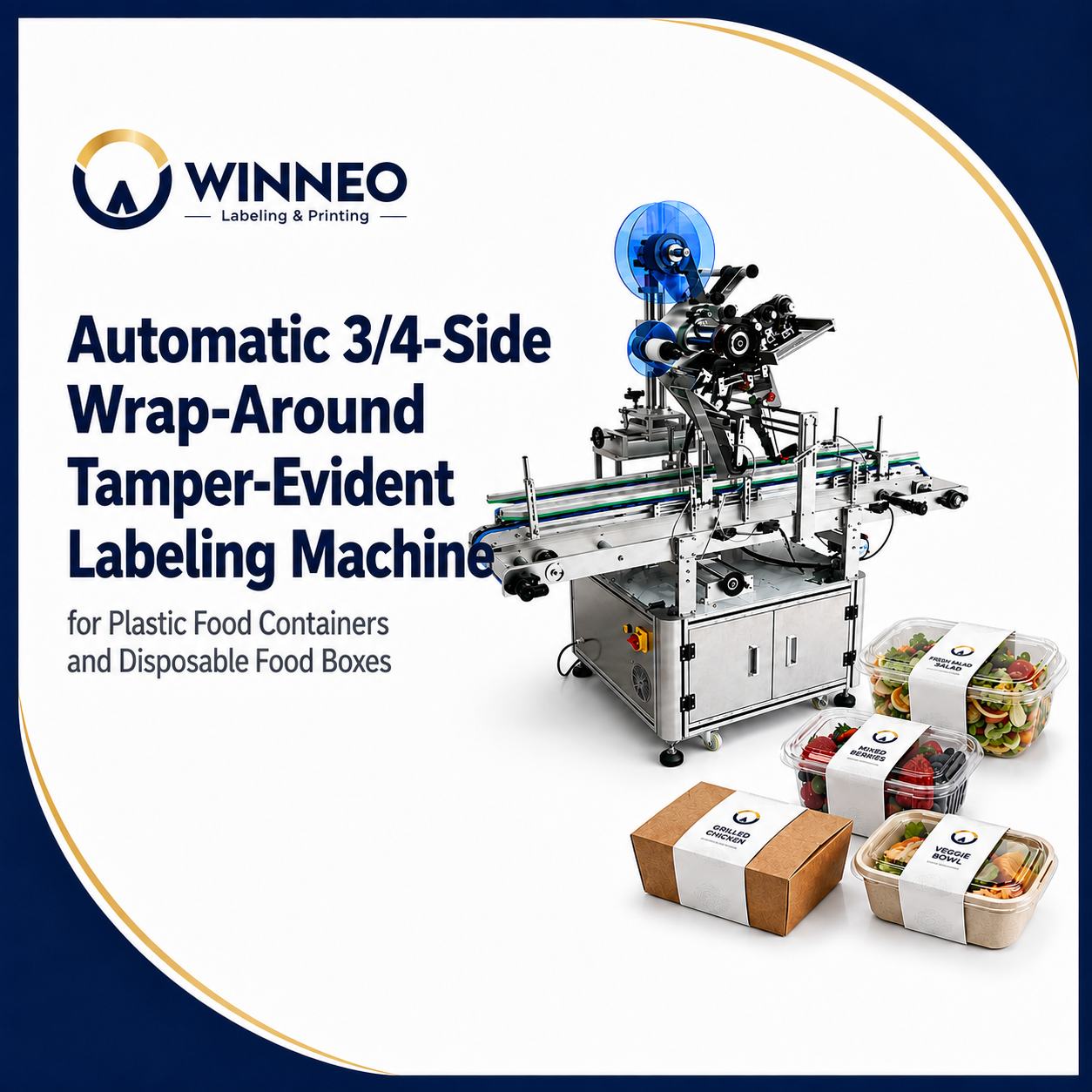
      In fast-growing food categories such as ready meals, fresh produce, salads, and grab-and-go foods, packaging labels must do far more than simply stick to a container. Brand and product information needs to be clearly visible on the top panel, while barcodes, specifications, ingredients, or traceability data must remain readable on the side panels. At the same time, every label must be applied consistently, labeling errors must stay under control, and production speed must keep pace with rising order volumes. Manual labeling and basic flat-surface labelers often struggle to meet all of these requirements at once. Misaligned labels, wrinkles, missed applications, rework, and inconsistent shelf appearance can increase labor costs and weaken customer confidence. For rectangular food trays and clear-lid containers, WINNEO offers an automatic food tray labeling machine that applies one continuous pressure-sensitive label across three sides in a single pass. The same platform can also be customized for four-side wrap labeling. This C-wrap labeling machine combines accurate product positioning, consistent label placement, clear information display, and an added tamper-evident effect—making it a practical upgrade for modern food packaging lines.   Why Are Food Trays Well Suited to C-Wrap Labeling? Food tray packaging has several labeling requirements that are difficult to achieve with separate hand-applied labels: •The top panel must present the brand, product name, and key selling information clearly. •Side panels must carry stable, readable barcodes, specifications, ingredients, or traceability data. •The final package must look consistent across every unit, with less dependence on operator skill. •The labeling process must keep pace with production growth without creating a bottleneck. A conventional process may require several labels and multiple application steps. This increases the risk of inaccurate positioning, wrinkles, missing labels, and inconsistent information placement. By contrast, a C-wrap labeling machine applies a single continuous label in one cycle. The label can cover the top and two opposite sides of the package; a customized four-side configuration can extend the wrap around an additional panel. This approach improves package appearance and creates an additional closure across the lid and tray. For brands that need visible package integrity, the system can also function as a tamper-evident labeling machine while keeping branding, regulatory information, and barcodes on one coordinated label.   Which Products Can This Automatic Food Tray Labeling Machine Handle? The system is particularly suitable for the following food packaging applications: Ready-meal trays Fresh fruit and vegetable containers Salad, deli, sushi, and prepared-food trays Vegetable packaging boxes Disposable food containers Clear-lid clamshell packs for bakery, produce, and grab-and-go foods The best match is a square or rectangular plastic tray with a flat top, a clear lid, and near-vertical side panels. These shapes allow the label to fold smoothly around the package, helping the food tray labeling machine maintain readable information and a clean appearance for retail shelves and e-commerce product images. When the package uses a hinged clear lid, the same configuration may also be described as a clamshell labeling machine. For buyers comparing equipment online, both terms are relevant: “food tray” describes the application, while “clamshell” describes the packaging format.   How the Three- or Four-Side Labeling Process Works 1. Product infeed and spacing: Trays enter the conveyor in a controlled sequence so that each product reaches the labeling station at the correct interval. 2. Product positioning: Guides and holding components stabilize the tray to reduce movement during label application. 3. Label dispensing: The labeling head releases one pressure-sensitive label according to the detected product position. 4. Multi-side wiping and wrapping: The label is pressed onto the top and folded across the selected side panels. The three-sided labeling machine completes the C-wrap in one continuous process; an engineered four-side version can wrap an additional face. 5. Inspection and discharge: The labeled tray leaves the station with branding and required product information presented in a consistent position.   Traditional Labeling vs. WINNEO C-Wrap Labeling Comparison Manual + Basic Flat Labeling WINNEO Automatic C-Wrap Labeling Label use Separate labels for the top and sides One continuous label covers the top and two sides Operation Multiple steps with manual start/stop handling Continuous in-line labeling process Labeling accuracy More operator-dependent variation ±1.0 mm, excluding product and label tolerances Output Lower speed and higher labor cost 15–30 products/min, depending on dimensions Information display Branding and barcode data may be split or incomplete Branding, product data, barcode, and QR code can be coordinated on one label Consistency and rework Higher variation and rework risk Stable positioning helps reduce rework   Core Technical Specifications Parameter Standard Reference Labeling accuracy ±1.0 mm (excluding product and label tolerances) Labeling speed 15–30 products/min (depending on product dimensions) Label roll core diameter 76 mm Maximum label roll outer diameter 280 mm Power supply 220 V Applicable product and label sizes Customized and confirmed for each application Actual specifications are finalized and tested according to the tray dimensions, label material, label layout, and production requirements supplied by the customer.   Frequently Asked Questions 1.What types of food packaging are suitable for C-wrap labeling? The system is best suited to square or rectangular food trays with flat tops and near-vertical side panels. Typical applications include ready-meal trays, fresh produce containers, salads, bakery clamshells, and other clear-lid food packs. 2.What is the difference between a C-wrap labeler and a standard wrap-around labeler? A C-wrap labeler applies one label across three connected faces of a tray, box, or clamshell. In many general web searches, “wrap-around labeler” refers to cylindrical bottles or jars. For rectangular food packs, C-wrap labeling machine or automatic food tray labeling machine is the more accurate product term. 3.Can the machine apply labels to three or four sides? Yes. The standard solution can apply one continuous label across three sides. A four-side configuration can be engineered according to the product shape, label size, folding path, and required information layout. 4.How fast can the machine label products? The standard reference speed is 15–30 products per minute. Actual output depends on tray dimensions, label dimensions, label material, conveyor coordination, and the final configuration. 5.Can WINNEO customize the machine? Yes. WINNEO can configure and test the food packaging labeling machine using the customer’s tray drawings, product samples, label samples, or label artwork. 6.How can I obtain a detailed solution and quotation? Provide the tray dimensions, label sample or drawing, target speed, and photos or video of the existing line. WINNEO can then evaluate compatibility and recommend an appropriate configuration and quotation.   Why Choose a Customized WINNEO C-Wrap Labeling Machine? Founded in 2006, WINNEO is a China-based brand with 20 years of experience in labeling, pad printing, screen printing equipment, and related consumables. We focus on practical machine customization for real products and real production conditions. For food packaging applications, WINNEO supplies three-side and four-side wrap labeling solutions and adjusts each project according to tray dimensions, required output, label material, information layout, and line integration. The goal is not simply to deliver an automatic labeling machine, but to provide a system that can be installed, operated, and maintained reliably in the customer’s production environment. Key advantages include: •Application-specific customization and trial setup based on actual products •Dedicated pre-shipment inspection with test documentation •Complete operation and training videos supplied with the machine •Long-term after-sales and spare-parts support •Competitive cost-performance and controlled lead times •Local distributor support in selected countries Request a Food Tray Labeling Solution If you need food tray labeling equipment that improves brand presentation, keeps product information complete, increases output, and reduces operator-dependent errors, a customized automatic food tray labeling machine is a strong balance of labeling performance and investment cost. Send WINNEO your product drawing, tray dimensions, label sample, target output, or production-line photos. Our team can quickly assess compatibility and recommend a suitable three-side or four-side labeling configuration with a project-specific quotation.  
    LEER MÁS
  • About Ceramic Pad Printing Machine FAQs
    About Ceramic Pad Printing Machine FAQs
    Jul 31, 2026
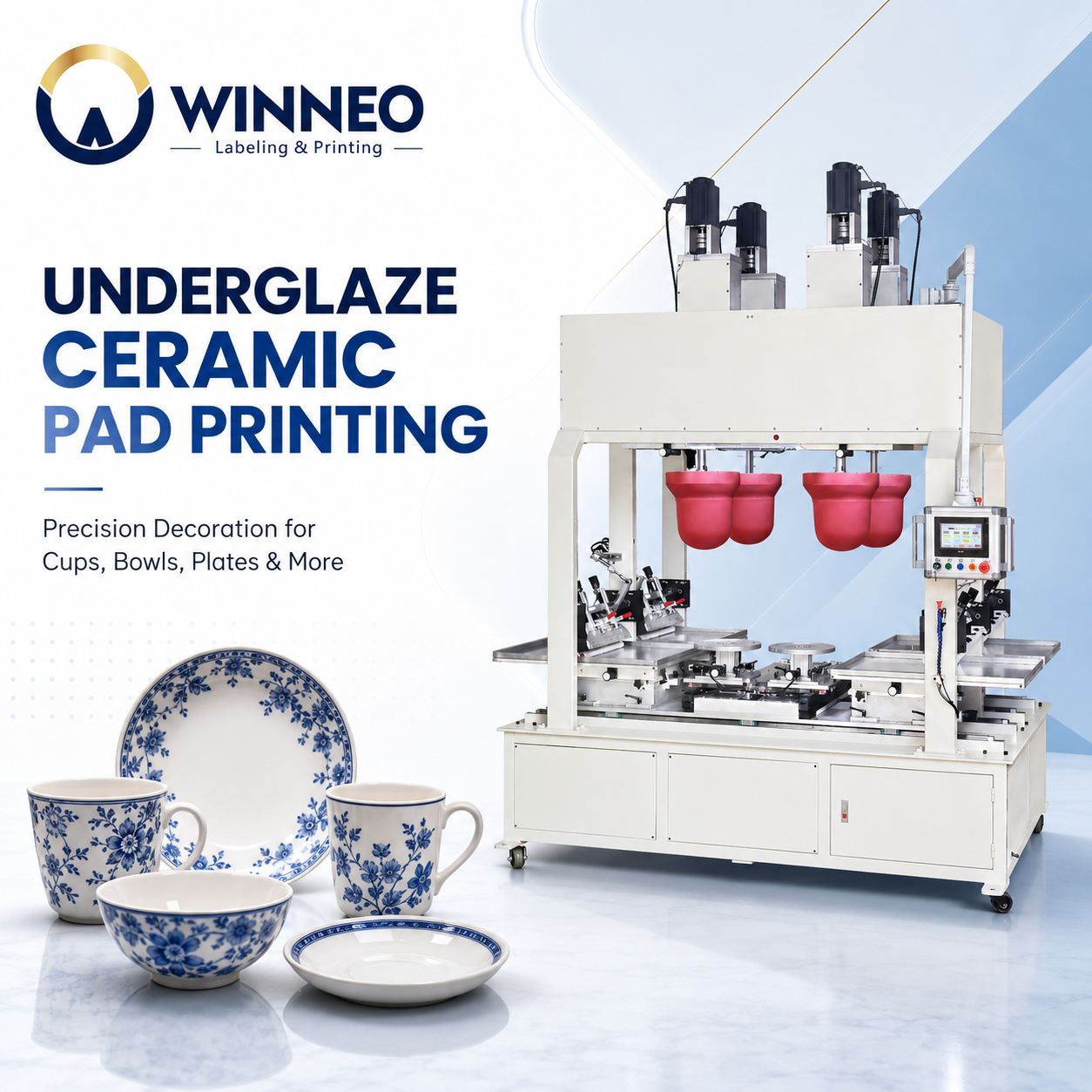
      The ceramic pad printing machine uses underglaze pad printing technology to transfer detailed patterns precisely onto ceramic bodies or beneath the glaze. After glazing and high-temperature firing, the design becomes integrated with the ceramic surface, delivering clear colors, excellent wear resistance and long-lasting print quality for ceramic cups, bowls, plates, saucers and more. About Ceramic Pad Printing Machine FAQs 1. What is a ceramic pad printing machine? A ceramic pad printing machine uses a flexible silicone pad to transfer patterns, logos or text from an engraved printing plate onto ceramic products. It is particularly suitable for curved, recessed and irregular surfaces. 2. What ceramic products can this machine print? WINNEO Automatic Ceramic Dishes/Plates/Bowls Pad Printing Machine can be configured for ceramic bowls, plates, cups, mugs, saucers, tiles, tableware, decorative ceramics and other shaped ceramic products. Custom fixtures and silicone pads may be required for different products. 3. Can it print on curved or irregular ceramic surfaces? Yes. The flexible silicone pad can adapt to curved and irregular surfaces, making pad printing suitable for areas that are difficult to print using conventional flat printing methods. 4. Can the machine print multiple colors? Yes. Multi-color ceramic pad printing machines can print two or more colors. Accurate color registration depends on the machine configuration, fixture precision, product consistency and process settings. 5. Is the ceramic pad printing process automatic? Yes. Depending on production requirements, the system can support automatic product feeding, positioning, printing, color registration and unloading. Semi-automatic configurations are also available for smaller production volumes. 6. What determines the printing speed? Printing speed depends on the number of colors, image size, ceramic product shape, loading method, ink drying requirements and level of automation. Actual output should be confirmed through product sample testing. 7. Is the printed pattern durable and dishwasher-resistant? We adopt under-glaze pad printing technology paired with ceramic-specific inks.The finished ceramic products are food-grade and safe for daily catering use, featuring excellent resistance to abrasion and chemicals, and are dishwasher-safe.To better meet customers’ practical demands, we still need to conduct verification tests tailored to each client’s actual application scenarios. 8. Does each ceramic product require a custom fixture? In most cases, yes. A suitable fixture keeps the product stable and accurately positioned during printing. Products with different sizes or shapes may require interchangeable or customized fixtures. 9. Can one machine print different ceramic products? Yes. The machine may be adapted to different products by changing the fixture, silicone pad, printing plate and process settings. The printable size and shape must remain within the machine’s working range. 10. What consumables are required? Common consumables include silicone printing pads, printing plates, ceramic-compatible inks, thinners, hardeners and cleaning materials. The exact consumables depend on the printing process and ceramic surface. About WINNEO Specialized in pad printing, screen printing and labeling solutions, we keep innovating to support manufacturers globally. We are dedicated to enhancing your printing processes by providing labeling equipment, pad and screen printing equipment, and related consumables. We work closely with you to deliver targeted solutions—making your print quality our mission and your success our future. WINNEO Specialist in Customized Labeling Machines & Screen Printing ,Pad Printing.
    LEER MÁS
  • How Pad Printing is Revolutionizing Underglaze Ceramic Production? A Complete Guide to the WINNEO 4-Color Ceramic Pad Printing Machine
    How Pad Printing is Revolutionizing Underglaze Ceramic Production? A Complete Guide to the WINNEO 4-Color Ceramic Pad Printing Machine
    Jul 21, 2026
    In the highly competitive ceramic manufacturing industry, the efficiency and quality of decoration processes directly determine a company's profit margins. Attention ceramic manufacturers! Are you still struggling with the following production pain points? ◆ Hand-painting processes are highly costly and inefficient, making it hard to meet large-volume orders. ◆ Traditional screen printing fails to handle complex curved surfaces and irregular shapes perfectly. ◆ Multi-color pattern printing suffers from unstable quality and misalignment, leading to a high rejection rate. If these issues resonate with you, then automated ceramic pad printing technology is the key to breaking through the bottleneck. Today, we will dive deep into how the WINNEO 4-color ceramic pad printing machine is bringing industry-level innovation to underglaze ceramic printing. 1. The Limitations of Traditional Ceramic Decoration For a long time, ceramic surface treatment has relied on manual painting or traditional screen printing. However, as the market demands more personalized and complex patterns, the drawbacks of traditional methods are becoming increasingly obvious: labor costs are rising year by year, and screen printing often falls short when it comes to curved surface ceramic printing. The precision of multi-color overprinting is also hard to guarantee. The industry urgently needs an automated ceramic printing equipment that combines high efficiency, high precision, and high flexibility. 2. The Game Changer: WINNEO 4-Color Ceramic Pad Printing Machine As an industry-leading solution, the WINNEO 4-color ceramic pad printer perfectly balances the triangle of "Efficiency × Quality × Cost Advantage." High Efficiency: With a printing speed of up to 5 products per minute (360 pieces/hour), it easily handles large-scale production. Ultra-Wide Format: Supports an ultra-wide printing range from 50mm to 400mm, meeting diverse needs from mini cups to large dinner plates. 3. Three Core Technical Advantages to Reshape Production Efficiency Advantage 1: Precision Servo Control System for Ultimate Clarity Equipped with advanced servo motors and linear guide rail systems. Compared to traditional pneumatic devices, it not only runs faster and positions more accurately but also operates with extremely low noise. Most importantly, it ensures uniform ink distribution without shifting, bringing the pattern clarity of underglaze ceramic printing to an unprecedented level. Advantage 2: Ultimate Surface Adaptability, Breaking Shape Limits Whether it's flat, curved, or irregular surfaces, the WINNEO pad printing machine can handle it with ease. By customizing silicone pads of various sizes and shapes, it comprehensively covers common categories such as ceramic cups, bowls, plates, and dishes, and can even print perfectly on both inner and outer surfaces, truly solving the industry challenge of curved surface ceramic printing. Advantage 3: Exceptional Cost Control to Boost Profit Margins When it comes to reducing ceramic production costs, the WINNEO 4-color ceramic pad printing machine performs exceptionally well. Its unique pad printing process ensures that the consumption of pigments and inks is far lower than that of screen printing and hand painting. Combined with its high capacity of 360 pieces/hour, it significantly reduces the labor and material costs per unit. 4. WINNEO Ceramic Underglaze Pad Printing Machine: Model Comparison & Selection Different product lines require the most suitable equipment. Please check the model comparison table above to understand the specific parameters and application scenarios of each model. Model Printing Speed Max. Printing Area Suitable Applications WP-CEREMIC-1 600-800 pcs/hour 420 x 420 mm Fast Single-Color Production WP-CEREMIC-2 600 pcs/hour 500 x 500 mm Fine Two-Color Patterns WP-CEREMIC-3 600 pcs/hour 320 x 320 mm Precision Three-Color Printing WP-CEREMIC-4 360 pcs/hour 400 x 400 mm Complex Four-Color Patterns Conclusion & Call to Action From manual to automated, from flat to complex curved surfaces, the WINNEO pad printing machine is redefining the standards of underglaze ceramic printing. If you want to increase capacity, reduce the rejection rate, and significantly cut production costs, now is the best time to upgrade your equipment. Click here to get a free quote Contact our technical experts to customize an exclusive ceramic printing solution for you! About WINNEO Specialized in pad printing, screen printing and labeling solutions, we keep innovating to support manufacturers globally. We are dedicated to enhancing your printing processes by providing labeling equipment, pad and screen printing equipment, and related consumables. We work closely with you to deliver targeted solutions—making your print quality our mission and your success our future. WINNEO Specialist in Customized Labeling Machines & Screen Printing ,Pad Printing.
    LEER MÁS
  • ¡Campeones! Spain Wins the 2026 World Cup — WINNEO Celebrates with Our Spanish Partners!
    ¡Campeones! Spain Wins the 2026 World Cup — WINNEO Celebrates with Our Spanish Partners!
    Jul 20, 2026
              Historic Victory · July 19, 2026 Congratulations, Spain! Spain Is the 2026 FIFA World Cup Champion A celebration of championship spirit, shared values and the global partnerships that continue to inspire WINNEO. 🏆 World Champions A Night of Football History The final whistle has blown, and the world witnessed history — Spain is the 2026 FIFA World Cup Champion! In a breathtaking final on July 19th, La Roja defeated Argentina 1-0 in extra time, with Ferran Torres delivering the decisive blow in the 106th minute. After 16 years, the trophy returns to Spain — and the celebrations are well deserved. Final Result Spain 1–0 Argentina Extra time · Winning goal in the 106th minute 🤝 A Message to Our Partners Here at WINNEO, we are proud to work alongside clients and partners across Spain and the broader Spanish-speaking world. Your passion, precision, and dedication inspire us every day — much like the Spanish national team's relentless spirit on the pitch.   A Champion’s Formula We Share Just like Spain's winning formula — discipline, teamwork, and precision — these are the same values we bring to every labeling and printing solution we deliver. 01 · Discipline Consistent Standards A disciplined approach to every stage of equipment design, production and service. 02 · Teamwork Global Cooperation Close collaboration with clients and partners to create suitable production solutions. 03 · Precision Reliable Performance Accurate labeling and printing solutions designed for stable industrial production. WINNEO Solutions Helping Your Production Line Perform Like a Champion Whether it's high-speed labeling machines, pad printing systems, or custom consumables, WINNEO is committed to helping your production line perform like a champion. High-Speed Labeling Machines Pad Printing Systems Custom Consumables   🏆 Congratulations to Spain and All Our Spanish-Speaking Partners Worldwide! From all of us at WINNEO — ¡Vamos España!
    LEER MÁS
  • Cómo solucionar el problema del etiquetado de tapas centrales: una máquina etiquetadora de sujeción automática mejora la calidad de la producción.
    Cómo solucionar el problema del etiquetado de tapas centrales: una máquina etiquetadora de sujeción automática mejora la calidad de la producción.
    Jul 12, 2026
     Cómo solucionar el problema del etiquetado de tapas centrales: una máquina etiquetadora de sujeción automática mejora la calidad de la producción.En muchos sectores, etiquetar una superficie plana es relativamente sencillo.Pero cuando se trata de tapones de botellas redondosLograr una etiqueta perfectamente centrada a alta velocidad se convierte en un verdadero desafío.Una pequeña desviación resulta muy visible en superficies circulares. Incluso una ligera desviación puede afectar la apariencia general del envase, disminuir la percepción de calidad del producto y aumentar los costos de reprocesamiento. Este es precisamente el reto al que se enfrentó nuestro cliente.El reto: Etiquetado centrado de alta velocidad en tapas redondasPara productos como:• Botellas de alimentos y bebidas• tarros de miel• envases de salsa• envases cosméticos• Frascos para el cuidado de la saludLos clientes suelen exigir que la etiqueta esté colocada exactamente en el centro de la tapa.Sin embargo, durante el proceso de etiquetado:•Los productos redondos pueden girar o desplazarse fácilmente durante el transporte.•El posicionamiento manual produce resultados inconsistentes.•Las máquinas de etiquetado plano tradicionales tienen dificultades para lograr un posicionamiento de tapas de alta precisión.¿El resultado?❌ Posición de etiquetado inestable❌ Mayor tasa de defectos❌ Mano de obra adicional para el reetiquetado❌ Mayores costos de producciónLa solución: Tecnología de posicionamiento de sujeción automáticaPara resolver este problema, desarrollamos un Máquina etiquetadora automática de sujeción plana Equipado con un mecanismo de sujeción específico.El sistema de sujeción funciona como una guía de posicionamiento:✅ Estabiliza el producto durante el transporte✅ Evita que la botella se mueva durante el etiquetado.✅ Garantiza un posicionamiento central preciso✅ Mejora la consistencia en la producción en masa.Al combinar sistemas de control precisos con posicionamiento mecánico, la máquina logra un rendimiento de etiquetado estable y repetible.Configuración técnicaPara garantizar un funcionamiento fiable, la máquina integra componentes industriales de alta calidad:⚙ Sistema de controlPLC Panasonic⚙ Sensor de detección de productoSensor Panasonic SUNX + Sistema de sensores de precisión⚙ Sistema de tracción y accionamiento de etiquetasSistema de motor paso a paso Leadshine⚙ Sistema de sujeción y accionamientoSistema de motor paso a paso LeadshineMejora del rendimientoTras actualizar a la solución de etiquetado con sujeción automática:Precisión del etiquetado±1 mmVelocidad de etiquetado40–80 piezas/minCalidad del productoAlto rendimiento con consistencia de etiquetado estable.OperaciónAjuste sencillo y configuración práctica.Flexibilidad de la aplicaciónTras el ajuste, la máquina puede procesar diferentes productos dentro del rango de tamaño adecuado, entre los que se incluyen:• Botellas redondas• Productos planos• Cajas• ContenedoresLa evolución de la tecnología de etiquetado1.0 Máquina etiquetadora semiautomática de alta precisión (WT101)2.0 Máquina etiquetadora plana totalmente automática (WT303)3.0 Máquina etiquetadora automática de sujeción plana✔ Alta precisión (hasta ±0,2 mm)✘ Requiere carga manual✘ Eficiencia de producción limitada✘ Velocidad: 15–25 piezas/min✔ Mayor velocidad de producción✔ Adecuado para la mayoría de productos planos✘ Todavía no se puede resolver perfectamente el etiquetado de tapas centrado de alta precisión.✔ Capacidad de etiquetado de tapas centradas✔ Producción de alta velocidad✔ Salida de calidad estable✔ Ajuste sencilloLa estructura de sujeción crea una nueva posibilidad:Alta precisión + Alta eficiencia + Alta flexibilidadResultados comerciales para los clientesEsta actualización aportó mejoras cuantificables:Mejor apariencia del productoLas etiquetas perfectamente centradas mejoran la calidad del embalaje y hacen que los productos luzcan más prémium en el estante.Costo laboral reducidoAl eliminar las correcciones manuales repetidas:De 2–3 operadores → 1 operadorReducción de residuos de etiquetasEl consumo de etiquetas se redujo en aproximadamente 20%Mejora de la calidad de producciónTasa de etiquetado defectuoso:Antes: 15–20%Después de la actualización: 0%ConclusiónPara los fabricantes que requieren un etiquetado uniforme y de alta calidad en tapones redondos y envases planos, el posicionamiento preciso es fundamental.La máquina etiquetadora de sujeción automática proporciona una solución práctica al combinar:✔ Posicionamiento estable del producto✔ Control de etiquetado preciso✔ Automatización de alta velocidad✔ Capacidad de aplicación flexibleUna pequeña mejora mecánica —el mecanismo de sujeción— puede generar una mejora significativa en la eficiencia de la producción y la calidad del producto.¿Necesita una solución de etiquetado para tapas centradas?Envíenos el diámetro de la tapa, las dimensiones del producto, el tamaño de la etiqueta, la velocidad requerida y fotos de muestra. Nuestros ingenieros evaluarán la aplicación y recomendarán la configuración de etiquetado más adecuada. Contacta con WINNEO por WhatsApp. Contacta con WINNEO rellenando el formulario.
    LEER MÁS
  • Why is D2 thick cliché plate the preferred choice for acidic substrates? The secret behind a one-million-impression lifespan.
    Why is D2 thick cliché plate the preferred choice for acidic substrates? The secret behind a one-million-impression lifespan.
    Jun 24, 2026
    Have you encountered issues such as premature corrosion of steel pad-printing plates or a decline in print quality? This may be due to excessive acidity in the substrate or the failure to select rust-resistant chromium steel for the plates.   An acidic environment accelerates the oxidation and corrosion of the steel plate, leading to: 1. Blurred edges of the printed pattern 2. Pitting on the steel plate surface 3. Significantly reduced printing lifespan   Three Key Advantages of the D2 Thick Cliché Plate: I. Exceptional Corrosion Resistance Its high chromium content (approximately 12%) provides excellent rust resistance, earning it the designation "semi-stainless steel."   II. Ultra-High Hardness and Wear Resistance ●Hardness reaches HRC 63 ± 1 after heat treatment. ●Scratch resistance withstands 600,000 to 1,000,000 cycles (7–10 times that of thick cliché plate 【Z01】) service life of standard Z01 thick cliché plate. III. Long-term Cost-Benefit Analysis Although WINNEO (D2) thick cliché plates require a higher initial investment, their service life is 5 to 10 times longer; this reduces the frequency of downtime for replacements and ensures consistent print quality, thereby lowering overall production costs. Furthermore, thanks to heat treatment, WINNEO’s high-quality chrome (D2) thick cliché plates can be reground and refurbished more than five times while maintaining performance comparable to that of a new plate.   IV. WINNEO Pad Printing Steel Plates–(D2) thick cliché plates Application Scenarios ●Electronic products (plastic parts with acidic coatings) ●Medical devices (requiring chemical corrosion resistance) ●Automotive components (exposed to corrosive environments)●Cosmetic packaging (containing alcohol and acidic ingredients) Our Commitment WINNEO will continue to provide customers with reliable machinery and equipment, high-quality services, and ample consumable supply solutions to ensure the normal operation of equipment and promote business growth.   We are not just your product supplier, but also your partner: Before sales, we actively work with you to determine product solutions; during sales, we improve and adjust products according to specific needs, and send product videos so you can witness the product in operation or be shipped firsthand. After sales, we can provide local or remote training and guidance for any related issues.   As a professional provider of pad screen printing and labeling products and services, WINNEO will provide solutions and continuous innovation for factories and users worldwide.
    LEER MÁS
  • WINNEO Latest Trends in Apparel Labeling Technology — Label-Free Pad Printing
    WINNEO Latest Trends in Apparel Labeling Technology — Label-Free Pad Printing
    Jun 05, 2026
    Label-free pad printing is a more cost-effective and flexible alternative to heat transfer printing and sewn labels.    Traditional garment factories still rely on screen printing or heat transfer printing for labeling. Screen printing has obvious limitations: it requires the fabric to be completely flat. However, finished garments feature curved necklines, uneven side seams and soft materials. When screen printing is forced onto these irregular surfaces, the screen stencil cannot fit closely against the fabric, resulting in incomplete patterns, ghosting, and even damage to the garments.   Heat transfer labels, by contrast, come with higher costs and longer production lead times, plus poor durability. Since heat transfer films are merely attached to the fabric surface, the labels tend to crack and deform after repeated bending, stretching or washing.     What’s more, heat transfer labeling requires at least two pieces of equipment: a printer and a heat press. Both devices increase energy consumption and generate large amounts of waste. The backing paper of heat transfer films is discarded after application, creating extra waste and bringing adverse impacts on environmental protection.     Advantages of Pad Printing   1.Excellent conformability Equipped with soft silicone pads that work just like stamps, the pads can flex freely and fit perfectly onto uneven surfaces. It can print labels directly on curved necklines, cuffs and wrinkled areas. This technology is applicable to all types of apparel, ranging from underwear to outerwear.   2.Superior durability The printing ink penetrates deep into the fabric and becomes an integral part of the garment. The pad printed labels can withstand numerous washes without cracking or peeling off.   3.High efficiency   Compared with other labeling methods, pad printing features instant drying. No heat bonding or additional dryers are required. This outstanding advantage is not only a major plus for apparel labeling manufacturers, but also an indispensable tool to help them expand their market share.       Advantages of Label-Free Pad Printing over Sewn Labels, Heat Transfer Labels and Screen Printed Labels         Components of WINNEO Fully Electric Tagless Printing Machine (Fabric Label Printing Machine)   1. WINNEO Tagless Printing Machine  This standalone label-tagless pad printing machine is specially developed by WINNEO for label printing on garments and fabrics: Fully electric design Low operating noise. No additional air compressor is required. The positioning accuracy reaches up to ±0.02mm. Fabric holding fixture Equipped with adhesive mats to fix fabrics firmly without causing damage. Built-in laser positioning cursor also makes alignment much easier. Shuttle-type silicone pads The pads move back and forth automatically for color printing. Frequent adjustment is not needed, so the machine is easy to operate. Even new operators can handle printing work effortlessly.     2. Pad Printing Plates (Clichés) We supply a full range of plate materials for printing applications, including:Compatible with Z01 thick plates, Z02 thick plates, D2 thick plates, ZT thick plates , carbon steel plates, stainless steel plates,aluminum plates,ceramic plates, etc.     3. Silicone Pads Garments vary in print pattern size and require pads with different hardness and softness. Besides standard silicone pads, WINNEO also provides customized pads to meet diverse demands.With 20 years of experience in the pad printing industry, we have built a comprehensive silicone pad database. Our professional team is ready to offer technical support and recommendations to help you select the most suitable pads.     4. Ink Cups & Rings Spare ink cups and blade rings are provided to improve ink changing efficiency.Our ink cups are compatible with equipment of other brands and available at competitive prices. We can also recommend matched blade rings according to your production capacity, helping you achieve optimal printing results within your budget.     5. Printing Inks Apparel pad printing inks need not only good printability, but also meet the following requirements: 1、Non-irritating to skin for comfortable wear; 2、Excellent wash and abrasion resistance: no color fading after repeated washing and long-term use; 3、Resistant to cracking when stretched.   Garment materials cover cotton, polyester, nylon, spandex, PU leather and various blended fabrics, all with distinct surface properties. Therefore, our inks are specially formulated to match different fabrics: 1、Good penetration and adhesion on natural fibers; 2、Strong surface bonding performance on chemical fibers; 3、Reliable stable adhesion on elastic materials.
    LEER MÁS
  • 【Ceramic vs Carbide 】Ink Cup Rings — Which One Should You Choose?
    【Ceramic vs Carbide 】Ink Cup Rings — Which One Should You Choose?
    May 22, 2026
    “Ceramic or carbide?” This is where most buyers get stuck. But the truth is: It’s not about which is better   It’s about which fits your pad printing machine and specific ink cups setup.     Quick Comparison Both materials serve different roles in modern pad printing ink cup systems. The choice directly impacts ink transfer quality, seal longevity, and line throughput.         How to Choose (Based on Your Application) ✅ Go for Ceramic Rings if you: l Run small batches / multiple SKUs l Use corrosive inks in your pad printing ink cup l Need a cost-effective & flexible solution l Prefer lighter equipment load on your press     ✅ Go for Carbide Rings if you: l Run high-volume, continuous production l Require high precision & consistency across every ink cups cycle l Operate in high-temperature environments l Want to minimize downtime & maintenance for your pad printing machine What Actually Matters Choosing the right ring is really about optimizing your:   ✔ Production stability ✔ Maintenance frequency ✔ Downtime ✔ Overall efficiencyNot just the material. About WINNEO Pad Printing Rings In real production, consistency is everything:   lPremium raw materials + heat treatment → durability & corrosion resistance lCNC precision machining → tight tolerances & tight tolerances & stability for any pad printing ink cup l100% inspection + simulation testing → reliable performance lMultiple sizes & customization → tight tolerances & stability for any pad printing ink cup     Bottom line: The best ring isn’t ceramic or carbide — it’s the one engineered for your pad printing machine workflow. If you're evaluating ink cup rings for your line,If you're evaluating ink cups or upgrading your pad printing ink cup components for your line Feel free to share your application — happy to exchange insights.
    LEER MÁS
  • Cómo funcionan las etiquetadoras para bolsas de plástico y botellas de vidrio
    Cómo funcionan las etiquetadoras para bolsas de plástico y botellas de vidrio
    Jan 13, 2026
    En el panorama moderno de la fabricación y el envasado, la presentación visual de un producto es tan vital como su propia calidad. Ya sea una elegante botella de vidrio con una bebida premium o una bolsa de plástico flexible con snacks orgánicos, la etiqueta actúa como el principal puente entre la marca y el consumidor. Sin embargo, aplicar estas etiquetas con precisión, rapidez y consistencia es una compleja proeza de ingeniería. Comprender cómo las máquinas etiquetadoras se adaptan a diferentes materiales (específicamente las superficies rígidas y cilíndricas de las botellas de vidrio y las superficies flexibles y a menudo irregulares de las bolsas de plástico) revela la increíble versatilidad de la tecnología de envasado.  Los fundamentos de la tecnología de etiquetado En esencia, cualquier sistema de etiquetado debe sincronizar tres movimientos críticos: la velocidad del transportador de producto, la velocidad de dispensado de la etiqueta y la presión de aplicación. Si bien la lógica subyacente se mantiene constante, las configuraciones del hardware varían significativamente según la geometría del contenedor. Para productores de pequeña escala o marcas boutique, una Máquina etiquetadora de escritorioOfrece el equilibrio perfecto entre espacio y eficiencia. Estas unidades compactas están diseñadas para manipular diversos contenedores, lo que permite a las empresas pasar de métodos manuales de "despegar y pegar" a la precisión automatizada sin requerir grandes superficies industriales. La anatomía de una etiquetadora automática Cada máquina etiquetadora generalmente consta de:El soporte de desenrollado: sostiene el rollo de etiquetas sensibles a la presión.La placa peladora: un borde afilado que fuerza a la etiqueta a separarse de su papel protector (el soporte).El motor de accionamiento: controla el tiempo de dispensación de etiquetas.El aplicador: el componente (rodillo, cepillo o aspiradora) que fija la etiqueta al producto.  Precisión en las curvas: etiquetado de botellas de vidrio Las botellas de vidrio presentan un desafío único debido a su rigidez y peso. La mayoría de las botellas de vidrio son cilíndricas, lo que requiere una técnica de "envoltura" para asegurar que la etiqueta esté centrada y sin burbujas.El método Wrap-around Cuando una botella de vidrio avanza por la línea, generalmente se separa mediante un tornillo de sincronización o una rueda separadora para garantizar que llegue al cabezal de etiquetado en el momento preciso. Para envases redondos, un Máquina etiquetadora de botellas redondasutiliza una "estación de envoltura" especializada. Al llegar la botella al aplicador, el borde delantero de la etiqueta se fija al vidrio. Simultáneamente, una correa motorizada o un conjunto de rodillos gira la botella. Este movimiento giratorio arrastra el resto de la etiqueta hacia la superficie, garantizando una aplicación uniforme de 360 ​​grados o una colocación perfectamente alineada de la parte frontal y posterior. Superando las imperfecciones del vidrio Aunque el vidrio es rígido, no siempre es perfecto. Pequeñas variaciones en el diámetro de la botella (conocidas como "conicidad") pueden provocar que las etiquetas se inclinen o se "espiralicen". Las etiquetadoras de botellas redondas de alta gama compensan esto permitiendo que el cabezal de etiquetado se incline ligeramente, adaptándose al contorno específico de la botella. Este nivel de ajuste es la razón por la que los sistemas automatizados superan con creces la mano de obra manual en las industrias de bebidas y farmacéutica de alto volumen.  Estabilidad en la flexibilidad: etiquetado de bolsas de plástico Etiquetar bolsas o sobres de plástico es una ciencia completamente distinta. A diferencia del vidrio, las bolsas de plástico son flexibles, ligeras y propensas a arrugarse. Si intenta etiquetar una bolsa llena de producto, la superficie irregular suele provocar que queden burbujas de aire y etiquetas torcidas. El enfoque "primero plano"Para lograr un aspecto profesional, las bolsas de plástico casi siempre se etiquetan vacías y planas. Esto garantiza que la superficie sea tan predecible como una hoja de papel. Para ello, los fabricantes utilizan un Máquina etiquetadora plana para bolsasEquipado con un alimentador automático por fricción. El proceso funciona de la siguiente manera: 1. Alimentación: Se coloca una pila de bolsas vacías en el alimentador. Una rueda de fricción de alta velocidad separa la bolsa inferior de la pila y la lanza a una cinta transportadora de vacío.2. Estabilización: La correa de vacío succiona la bolsa hacia abajo, evitando que se mueva o se agite a medida que se mueve hacia el cabezal de etiquetado.3. Aplicación: La etiqueta se dispensa desde arriba. Dado que la bolsa es plana y está sujeta por la cinta transportadora, la máquina puede aplicar una presión considerable mediante un rodillo de goma para asegurar que el adhesivo se adhiera instantáneamente al plástico.  Diferencias clave en el manejo de materiales CaracterísticaEtiquetado de botellas de vidrioEtiquetado de bolsas de plásticoEstado materialRígido y pesadoFlexible y ligeroProblema comúnBurbujas y sesgosArrugas y estáticaManipulación de productosEspaciados por tornillos de sincronizaciónAlimentado por alimentadores de fricciónEstilo de aplicaciónEnvolvente o panel lateralAplicación plana de arriba hacia abajo  El papel de los adhesivos El material también determina el tipo de adhesivo utilizado. El vidrio no es poroso y puede estar frío o húmedo (especialmente en el envasado de bebidas), por lo que requiere adhesivos resistentes a la humedad. Las bolsas de plástico, a menudo de polietileno o polipropileno, tienen baja energía superficial, lo que significa que las etiquetas necesitan un adhesivo de alta adherencia para evitar que los bordes se despeguen con el tiempo (un fenómeno conocido como "flagging").  Por qué es importante la automatización Cambiar de la aplicación manual a una máquina etiquetadora de escritorio o una línea totalmente integrada ofrece tres beneficios principales: 1. Precisión y marca Una etiqueta torcida en un frasco de perfume de lujo o una pegatina desalineada en una bolsa de café transmiten una señal de mala calidad al consumidor. La automatización garantiza que cada unidad tenga la misma apariencia, lo que refuerza la confianza en la marca. 2. Eficiencia de rendimiento Un trabajador manual puede etiquetar de 5 a 10 botellas por minuto con distintos grados de precisión. Una etiquetadora básica de botellas redondas puede procesar fácilmente de 30 a 60 unidades por minuto, mientras que las líneas industriales de alta velocidad pueden superar las 200 unidades por minuto. 3. Reducción de residuos El etiquetado manual suele provocar la pérdida de etiquetas debido a errores humanos. La desalineación suele provocar que la etiqueta se despegue y se deseche. Las máquinas utilizan sensores (ojos fotoeléctricos) para detectar el producto y el espacio entre las etiquetas, reduciendo el desperdicio prácticamente a cero.  Cómo elegir la máquina adecuada para su negocio Si su negocio está en crecimiento, la elección del equipo depende enteramente del formato de su embalaje. Para cervecerías artesanales y bodegas: Una etiquetadora de botellas redondas es el estándar de la industria. Busque modelos que admitan botellas de diferentes alturas y diámetros para asegurar el futuro de su producción.Para productores de alimentos y marcas de ropa: Si empaca artículos en bolsas de fondo plano o sobres de polietileno, una etiquetadora plana para bolsas es esencial. La clave está en incluir un alimentador; sin él, tendrá que alimentar las bolsas manualmente una por una.Para versatilidad general: si su línea de productos incluye tanto frascos como cajas, una plataforma de máquina etiquetadora de escritorio modular permite la mayor flexibilidad.  El futuro del etiquetado A medida que nos acercamos a 2026 y más allá, la tecnología de etiquetado se vuelve aún más inteligente. Estamos viendo la integración de sistemas de visión que verifican la presencia de etiquetas y OCR (Reconocimiento Óptico de Caracteres) para garantizar que las fechas de caducidad impresas en las etiquetas sean legibles. Además, el auge de los envases ecológicos significa que las máquinas se están recalibrando para manejar etiquetas más delgadas y compostables y sistemas de etiquetado "sin soporte" que eliminan el desperdicio de papel de soporte. Independientemente del material, ya sea la clásica elegancia del vidrio o la moderna practicidad del plástico, la tecnología detrás de la etiqueta sigue siendo un pilar fundamental de la cadena de suministro global. Al invertir en las soluciones automatizadas adecuadas, las empresas garantizan una primera impresión perfecta en el lineal.  
    LEER MÁS
1 2 3 4

dejar un mensaje

dejar un mensaje
Si está interesado en nuestros productos y desea conocer más detalles, deje un mensaje aquí, le responderemos lo antes posible.
entregar

Tiempo de trabajo

Recibe tu información las 24 horas del día

Hora de Pekín: Lunes a viernes de 9:00 a 17:30


CONTÁCTENOS :info@glwinneo.com

Hogar

Productos

whatsApp

contacto